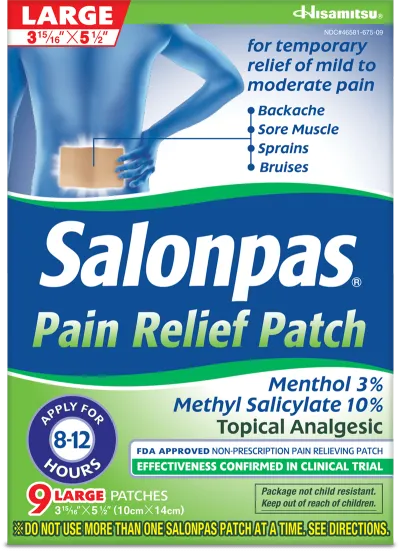
Background
While both menthol and methyl salicylate are available in various over-the-counter creams, gels and patches for the temporary relief of mild pain, there is limited published data regarding the effectiveness of either active ingredient alone or in combination.
As a result of this study, Salonpas Pain Relief Patch Large resulted in 40% greater pain relief than placebo, with a P value of < 0.005. Subsequently, this was the first OTC topical pain relief product to be approved by the FDA through a New Drug Application (NDA) for mild to moderate pain, and as of 2025, it is still the only FDA approved topical pain relief patch product for mild pain with moderate pain indication. Furthermore, no other OTC topical pain relief patch is labeled for up to 12 hours of use.
Study Design
Double-blind, parallel-group, placebo-controlled, randomized, multi-center trial. Adult patients 18 years and older with muscle strain were screened to determine eligibility.
Objective
Evaluate the efficacy and safety of a 10% methyl salicylate / 3% l-menthol patch versus placebo in adults with muscle strain.
Methodology
Study flow: 12 hour assessment window
- Screening: Adults (18+) diagnosed with mild moderate muscle strain
- Randomization: Participants assigned to active patch or placebo patch. Double-blind (no one knew which patch they received).
- Baseline & Application: Before applying the active or placebo patch, participants rated their baseline pain intensity, at rest and with movement. Then, a single patch was applied to the affected area (e.g., shoulder, upper back, abdomen, neck, calf, thigh, forearm).
- Pain Measurement: Hourly Visual Analogue Scale ratings (0–100) at rest and with movement for 12 hours.
Pain measurement & primary endpoint
- Instrument: 100-mm Visual Analogue Scale
- Conditions: Rest + movement
- Safety: Adverse event tracking
- Primary Endpoint: Summed Pain Intensity Difference scale (SPID) was used to quantify cumulative pain reduction over time. In this case, the first 8 hours.
- Secondary Endpoints: Pain at rest, Total pain (TOTPAR), and Total pain with movement.
Plain-Language Primary Question: Did the medicated patch reduce pain better than the placebo patch during the first 8 hours?
Patient Population
208 Patients
104 men, 104 women; (age 18–78 years) diagnosed with muscle strain.
105 Patients
Active patch
(mean age 37.3)
103 Patients
Placebo patch
(mean age 38.1)
Sites: Shoulder, upper back, upper arm, neck, calf, thigh, forearm, or abdomen
Results
Out of 208 participants that completed the study, those wearing the active patch had ~40% more pain relief than those with the placebo patch. Side effects were rare (about 6-7%) and mild in both groups. The patch was both effective and safe.
These included: SPID8 values with movement (ITT population, LOCF; P = 0.032); TOTPAR scores (8 hours) with movement (P = 0.017); and TOTPAR scores *8 hours) with movement (P = 0.002).
Primary Efficacy Result (SPID8, With Movement)
P = 0.005. Interpretable effect statement reported: ~40% greater pain relief with active patch vs. placebo.
- Active Patch
- Placebo
Key stats (quick reference)
| Category | Details |
| Design | Randomized, double-blind, parallel-group, placebo-controlled, multicenter |
| Population | 208 adults (18–78 yrs) with muscle strain |
| Intervention | Single 10% methyl salicylate / 3% l-menthol patch applied to the affected area |
| Comparator | Placebo patch |
| Pain Assessment | 100-mm VAS with movement; At baseline, 74% of participants reported moderate pain |
| Primary Endpoint | SPID8 (first 8 hours) |
| Primary Result (SPID8, Rest) | Active vs placebo (mean [SD]): 182.6 (131.2) vs 130.1 (144.1); P = 0.005 |
| Reported Effect | ~40% greater pain relief with active patch vs placebo |
| Satisfaction | 58% rated satisfaction as good, very good, or excellent |